

A private clinic website now needs to do much more than list services and contact details.
Patients may be researching a condition for the first time, comparing consultants, checking whether treatment is self-pay or insured, looking at fees, and deciding what happens after they make contact. For specialist or higher-value care, they may return several times before enquiring.
A strong website helps patients answer: Is this the right service for me? Can I trust this clinician and clinic? How much will it cost? Can I use insurance? What happens if I book?
The goal is a clearer journey from first visit to consultation and follow-up, rather than technology for its own sake. The wider principles in what a healthcare website should include apply here too.
1. A Clear Homepage
The homepage should quickly explain the clinic’s specialisms, who it serves, its main services, whether it accepts self-pay and insured patients, its location and how to book or enquire. A patient should not need to search several pages for those basics.
2. Dedicated Service and Treatment Pages
Give important consultations and treatments their own clear pages. Explain what the service is, who it may suit, what a consultation involves, any preparation, who delivers it, indicative fees where appropriate and the next step. Use patient-friendly language and distinguish general information from advice that requires individual assessment.
A useful page should answer the questions a patient has before asking them to make contact.
3. Clinician and Consultant Profiles
For many patients, choosing a clinician is central to choosing a clinic. Profiles should show the clinician’s name, role, qualifications, areas of expertise, relevant experience, professional registrations, memberships genuinely held and a professional photograph. Keep every credential accurate and verifiable. Do not imply specialist status or awards the person does not hold.
4. Self-Pay and Insured Patient Journeys
A self-pay patient may research, compare, check fees, book, pay and attend. An insured patient may first need to check cover and authorisation before choosing a consultant. Specialist consultations and follow-up visits may have different routes again. Show the relevant next step for each, without pretending the operational processes are identical.

5. Online Booking and Consultation Requests
Where appropriate, let patients move from a service page to consultation booking and confirmation. Other services may require an enquiry, triage or consultant review before an appointment can be offered. Explain what happens after submission, including whether the request is confirmed or still awaiting review.
Instant booking is not suitable for every clinical service or insurer process. Our guide to improving online booking journeys for healthcare businesses explores these decisions in more detail.
6. Pricing and Consultation Fees
Patients often need some understanding of cost before contacting a private clinic. Where appropriate, show consultation fees, treatment or starting prices, deposits, follow-up fees, cancellation terms and possible additional costs. If a final price depends on assessment, say so plainly. Avoid a low headline price that hides material costs; clear pricing information helps people assess their options.
7. Private Medical Insurance Information
If the clinic works with insurers, explain which patients it accepts and whether authorisation is needed. Clarify whether patients should contact their insurer first, what details the clinic may need and that excesses or exclusions may apply. Individual policies differ, so avoid presenting one process as universal.
8. Payments and Deposits
For suitable services, a booking may lead to a deposit and confirmation, or an approved consultation request may lead to payment and an appointment. Make charges transparent, use an appropriate secure process and connect payment to the booking journey. Do not force advance payment where it is clinically or operationally unsuitable.
9. Patient Forms
Digital forms can support registration, medical history, consultation requests, screening and appropriate consent processes. Ask only for information needed at that stage, avoid repeated entry and preserve the clinic’s clinical, privacy and regulatory requirements.
10. Trust Before Booking
Health concerns, specialist care, cost and sensitive information make trust particularly important. Clinician details, clear services, fees, professional credentials, location, privacy information and an understandable next step should be accurate and consistent. Decorative claims cannot replace details patients can verify. Our article on why healthcare websites lose enquiries before contact covers common gaps.

11. Patient Reviews and Testimonials
Where reviews are used, publish genuine patient feedback, attribute it appropriately and avoid exaggerating outcomes or implying guaranteed clinical results. A fabricated testimonial can undermine precisely the trust the website is meant to build.
12. Privacy and Data Security
A private clinic may collect sensitive health information. Make its privacy information easy to find and explain how personal data, forms and payments are handled where applicable. Avoid technical security promises that have not been verified.
13. Location and Accessibility
Show the full address, map, current opening hours, telephone and contact route. Add parking, public transport and physical accessibility details where relevant. Keep information consistent across the site and other listings.
14. Mobile Experience
Test whether patients can comfortably read services, compare clinicians, see fees, check insurance information, complete forms, book or enquire, pay where relevant and read confirmations on a phone. A responsive layout alone does not prove that these tasks are easy.
15. Appointment Confirmations and Reminders
After an enquiry or booking, patients should understand its status. Useful messages may include the appointment details, location, clinician, preparation instructions, payment confirmation, reminders and cancellation or rescheduling information. Each automated message should serve a clear purpose.
16. Follow-Up Journeys
The digital experience continues after a consultation. Where appropriate, connected systems can support follow-up appointments, repeat consultations, forms, patient information, results communication pathways and reminders. The process should reflect the clinic’s clinical and operational model.
17. Analytics and Measurement
Service and clinician page visits, booking clicks, enquiry submissions, completed bookings, payment completion, device type, traffic sources and drop-off points can reveal patterns. Google Analytics and Microsoft Clarity can help, but interpret the data alongside patient feedback and operational context. Do not treat every drop-off as proof of a problem.
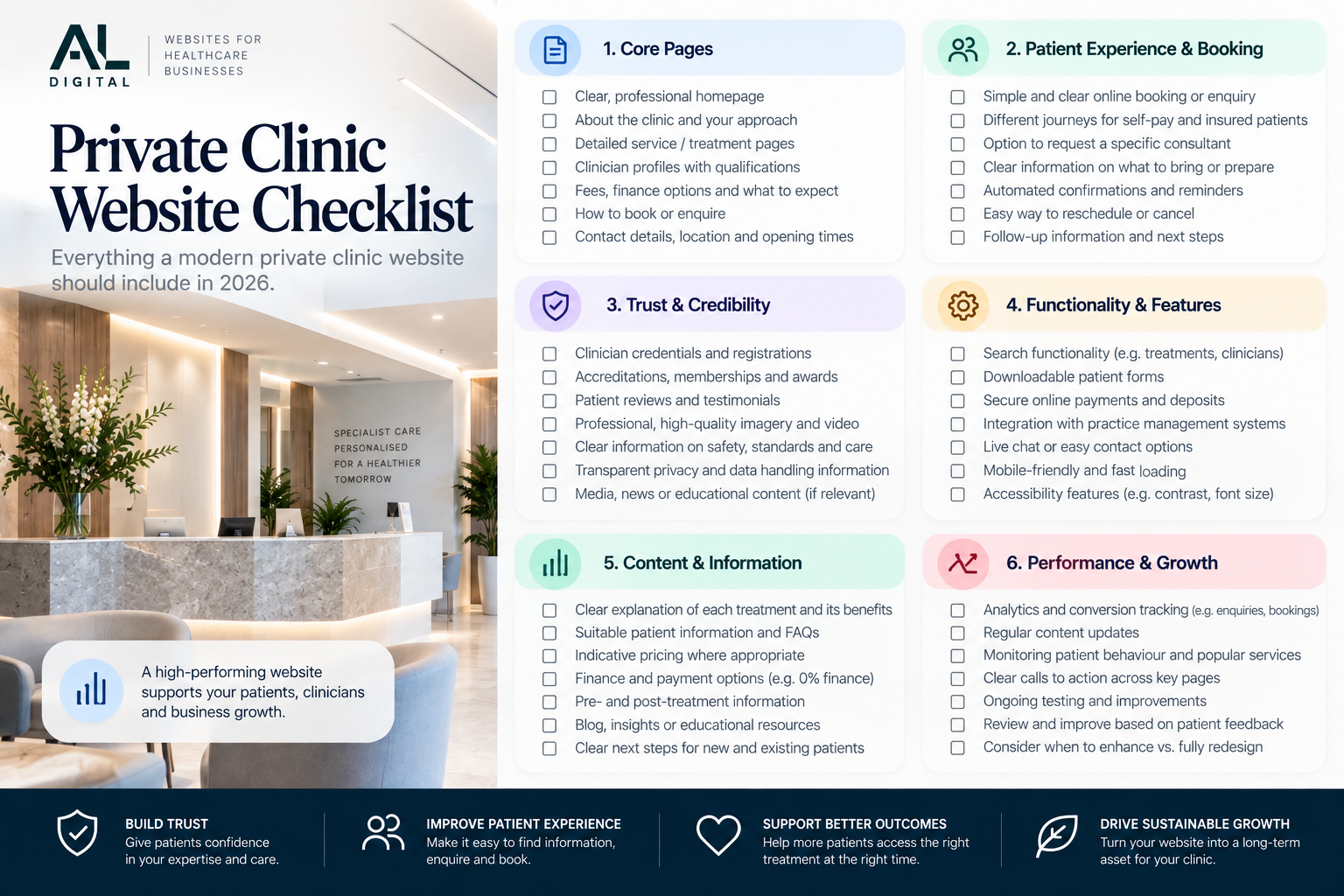
Private Clinic Website Checklist
Before rebuilding an entire clinic website, review the existing patient journey and identify where information, trust or booking processes are unnecessarily difficult.
Does Every Private Clinic Need a New Website?
Not necessarily. If the technical foundation is strong, better service pages and clinician profiles, clearer fees, distinct self-pay and insured pathways, improved forms, mobile usability, analytics and integrations may be enough. A rebuild becomes more relevant when the platform or structure prevents those improvements.
Our guide to website redesign versus a new website helps frame the decision. Explore AL Digital’s services and case studies for more context. Related guides cover independent pharmacy websites and dental practice websites.
The Goal Is a Connected Private Patient Journey
A strong private clinic website helps patients understand the route from service to clinician, cost, booking, confirmation, consultation and follow-up. The best experience fits the clinic and makes that route clear.
Is your private clinic website making it easy for patients to understand their options and take the next step?
AL Digital builds websites and connected digital systems around patient journeys, bookings, enquiries, payments and business workflows.
Explore Healthcare SolutionsGet a Free Quote